
West Ham to Lodge Formal PGMOL Complaint Over Arsenal VAR Call That Could Send Them Down

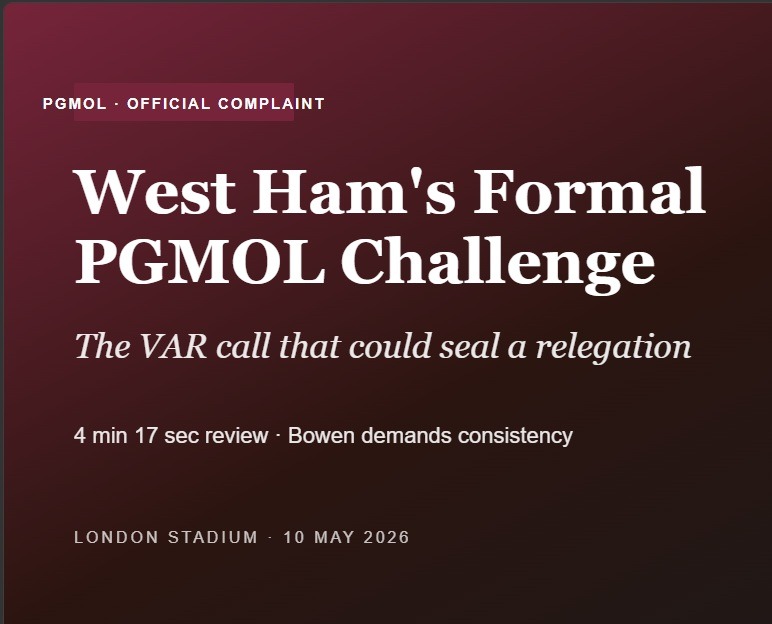
West Ham United will formally contact the Professional Game Match Officials Limited in the coming days to register their objection to the VAR decision that denied them a dramatic late equaliser against Arsenal on Sunday 10 May 2026. According to reports in The Times, the club will also request access to the audio conversations between on-field referee Chris Kavanagh and VAR official Darren England that took place during the four-minute, 17-second review that led to Callum Wilson's goal being scratched from the board.
What West Ham Are Disputing
The Hammers do not dispute that Wilson's goal was correctly disallowed on its own terms. The footage of substitute Pablo holding goalkeeper David Raya's arm during the corner was clear enough. What the club intend to challenge is the application of consistency. Captain Jarrod Bowen made this point clearly in the immediate aftermath, asking how routinely referees plan to penalise holding in the penalty area from set pieces and whether the bar applied to Pablo on Sunday will be applied in the same way every week.
That is a legitimate football governance question, and it is the same question West Ham raised after a similarly controversial VAR overturn in the 2022-23 season. The cycle is a familiar one: a high-stakes game, a borderline call, a formal complaint, a closed-door conversation with PGMOL, and a brief acknowledgement before life returns to normal. What is different in May 2026 is the scale of what is at stake. Arsenal are now two wins from the Premier League title. West Ham are in the relegation zone and running out of time.
What a Complaint Actually Achieves
In practical terms, a PGMOL complaint is procedural. It does not change the result, earn a rematch or result in disciplinary action against any official. What it does is create a formal record and, in theory, contribute to a broader conversation about consistency of officiating standards. West Ham also want access to the VAR audio, a request that the Premier League and PGMOL have sometimes honoured with selective disclosure.
West Ham's situation is not unlike the scenario outlined in our low-score correct score predictions guide: a 1-0 match that was never really comfortable for the winner, contested until the very last seconds and settled by a marginal event. The fact that both sides had xG profiles pointing to a draw or narrow win makes the margin and its consequences even more keenly felt.
The Relegation Stakes Behind the Complaint
The subtext of the complaint is, of course, relegation. West Ham have been members of the Premier League since 2012, and the financial consequences of dropping to the Championship are enormous. Losing a potential point to a four-minute VAR review at the London Stadium, when Nottingham Forest and Leeds are confirmed safe, leaves the Hammers' fate hanging on a miraculous final two-game run while simultaneously hoping Tottenham collapse.
West Ham still have to play Newcastle away and Leeds at home. Tottenham face Chelsea away and Everton at home with a game in hand, meaning they can move four points clear with a win over Leeds on Monday night. The arithmetic is uncomfortable for David Moyes' successor, and the PGMOL complaint represents the only avenue left to express the club's frustration through official channels.
Will It Matter?
History suggests formal complaints rarely produce meaningful change. Leeds United's objections to specific officiating decisions during their title-chasing season in the early 2020s produced no tangible result. Arsenal's 2023 statement about refereeing standards was received coolly by PGMOL. But West Ham will file the paperwork anyway, because at this point it is the only move available to them that is not purely about what happens on the pitch in the next fortnight.
The question of whether VAR is systematically applying its goalkeeper protection protocols consistently is one the league cannot avoid addressing. Sunday's review produced a decision that most experts agreed was technically correct. Whether it was proportionately correct is another matter entirely.