
How Cambridge University Became the Birthplace of Modern Football — and Why It Matters in a World Cup Year

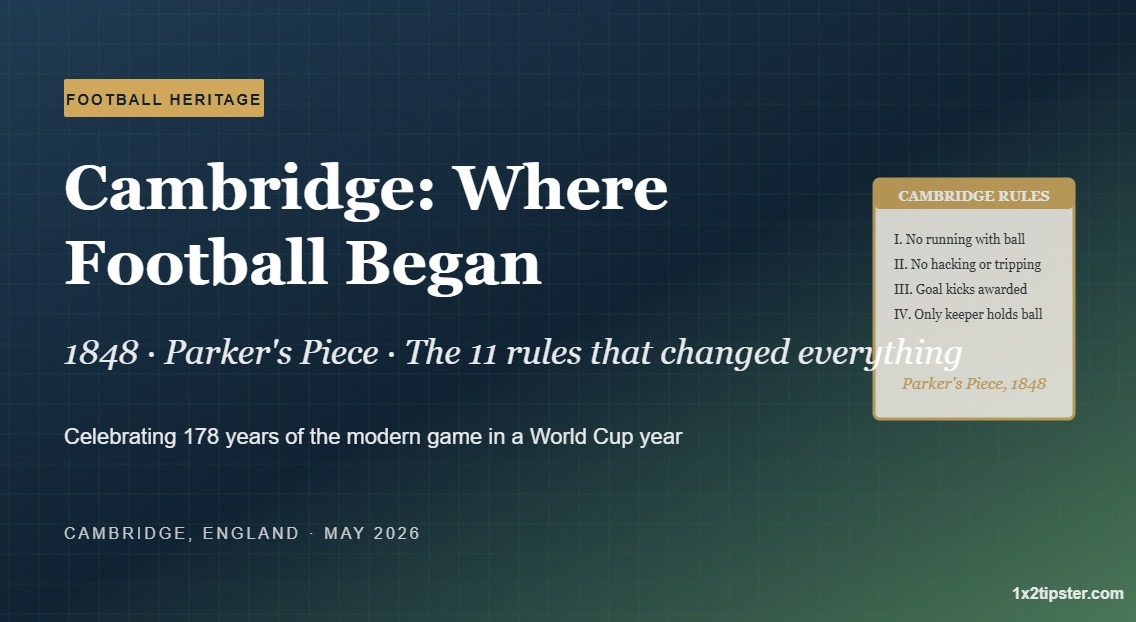
As the 2026 FIFA World Cup prepares to kick off in the United States next month, drawing billions of viewers and tens of thousands of international visitors to matches across North America, the University of Cambridge has been celebrated in a series of events marking its unique place in football history. Cambridge University's role in codifying the game's rules in 1848 — 15 years before the Football Association was formally established — has been highlighted by the university and its football club as the World Cup year invites the world to reflect on football's origins.
Parker's Piece: Where the Game Began
The story begins on a 25-acre open common near the heart of Cambridge called Parker's Piece. In 1848, students from Trinity College sat down to resolve a problem that had made inter-university football nearly impossible: every player had grown up in a different school with a different version of the game. Eton men refused to allow handling; Rugby players carried the ball freely; Harrow men demanded their own offside rules.
A small group of students spent hours at a table, each bringing their school's rulebook, and produced what became known as the Cambridge Rules — 11 concise regulations that prohibited running with the ball, banned hacking and tripping, introduced the goal kick and created the framework that the Football Association eventually adopted in modified form in 1863. Copies of the rules were pinned to the trees surrounding Parker's Piece, and very quickly, as one participant described it, "they worked very satisfactorily."
A 2026 Milestone Year
Cambridge City Council and the University have been marking 2026 as a significant milestone in the ongoing celebration of football's origins. Cambridge University Association Football Club — which regards itself as unofficially the oldest football club in the world — has formalised a partnership with Cambridge United FC as part of this year's recognition. Professor David Cardwell, of CUAFC, has described Parker's Piece as the location where "the DNA of the game was discovered."
The physical monument to this history is a stone sculpture installed on Parker's Piece in 2018, inscribed with the 1848 rules in multiple languages and positioned at the very corner where the original written rules were first displayed. As World Cup fever builds and football's global reach is once again on full display, Cambridge's claim to be where it all began resonates more than ever.
Why Football's Origins Matter for Modern Prediction
Understanding where the rules of football came from is more than historical curiosity. The 11 rules codified in Cambridge in 1848 — most of which survive in recognisable form in today's Laws of the Game — established football as a sport built around skill and teamwork rather than physical force. That philosophical foundation shapes the statistical patterns that modern predictive models rely on.
The game was designed to reward passing, positioning and technical quality, which is why long-run form, xG trends and player-level data are more predictive of outcomes than brute-force statistics. Our building your own football prediction model guide traces modern prediction methodology back to the structural principles that Cambridge enshrined: a game of consistent rules, repeatable patterns and statistical law.
From Parker's Piece to 48 Teams in North America
The scale of football's growth from that Cambridge meeting in 1848 to the 2026 World Cup is difficult to comprehend. The 32-team format has now expanded to 48 teams. The tournament spans three countries and 16 venues. Billions of people will watch it. FIFA estimates that the 2026 event will be the most-viewed sporting event in human history.
That journey traces back, in a direct and unbroken line, to a small patch of grass in Cambridge where students decided that a game worth playing was a game worth defining properly. As football's greatest tournament prepares to take over North America in June, Parker's Piece deserves its moment in the spotlight.
The Football Association formally acknowledged in 1863 that the Cambridge Rules were "the most desirable for the Association to adopt." One hundred and seventy-eight years later, the game those rules created is the most watched sport on the planet.