
Football on Ruins: Gaza's Orphan Teenagers Keep the Game Alive Amid Devastation

Sixteen-year-old Mohammed Eyad Azzam walks three to four kilometers through rubble, tents and displaced families every time he wants to play football. Before he leaves, he lights fires and carries water containers for his elderly grandmother — the only family member he has left after an Israeli air strike killed the rest of his family at their home in Jabalia in October 2024. At the end of the walk, he laces up his boots, steps onto one of the last remaining football pitches in Gaza and plays.
"My life flipped from happiness to grief," Mohammed told Al Jazeera. "I used to be pampered, but now I am responsible for everything." Football, he said, is the only escape from that daily turmoil.
What the Statistics Don't Capture
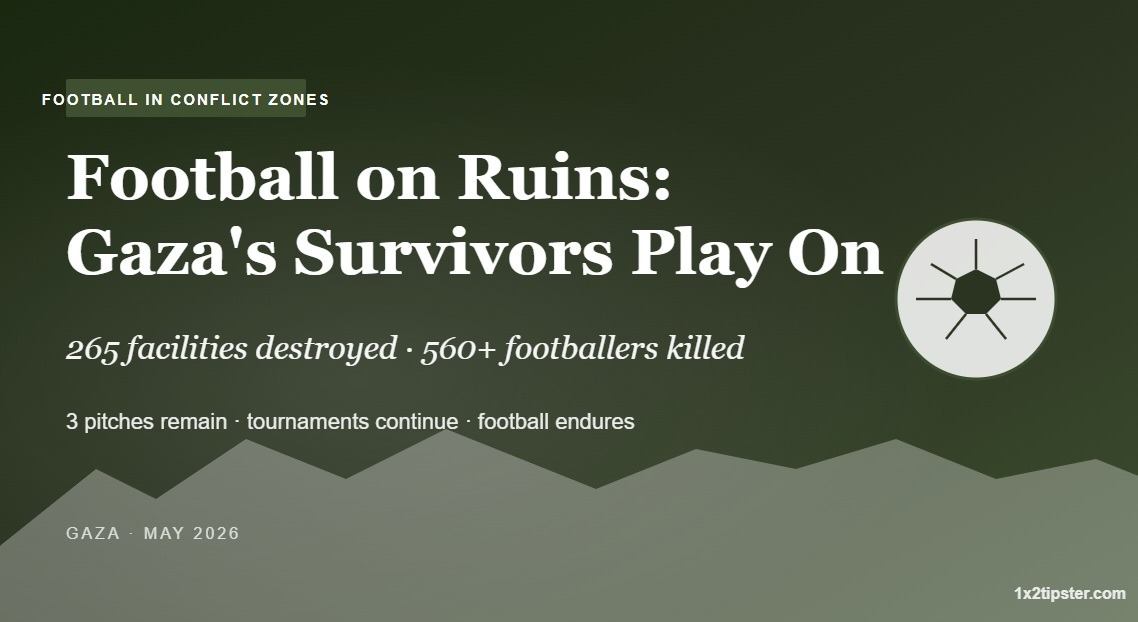
The Palestinian Football Association reports that 1,113 people affiliated with the sports sector in Gaza have been killed since the conflict began, including more than 560 footballers, coaches and administrators. All 56 football clubs in Gaza have been severely affected. Of 265 sports facilities identified across the Strip, every one has been destroyed or damaged. The main stadiums have either been bombed or converted into shelters for displaced families.
What remains: three small pitches — Palestine Stadium in Gaza City, Khadamat Nuseirat and Ittihad Shabab Deir al-Balah — where the Palestinian Football Association has been organising youth tournaments for players born in 2009. Mohammed is one of tens of thousands of children who have lost their families, their clubs, their academies and their education, according to the PFA's Mustafa Siyam. And yet they come, tired before they even step onto the field, to play the game.
Why Football Endures
There is something in the persistence of football in Gaza that speaks to the reason the game exists at all. It was not invented by corporations or broadcast rights or sponsorship deals. It was invented by people who needed to define how to play fairly together — in Cambridge in 1848, and in every school yard, back alley and cleared patch of ground that followed. Mohammed Eyad Azzam playing through exhaustion on a pitch surrounded by ruins is the most literal expression of that impulse.
Mustafa Siyam of the PFA acknowledges the grave risks youngsters face on their way to and from matches. Security deteriorates without warning; routes that were passable yesterday may not be safe today. "Despite all these measures," Siyam said, echoing the view of the West Bank-based Palestinian football administration, "sport has not been eliminated."
The World Cup Year Context
As the 2026 FIFA World Cup prepares to bring a spectacle of global football to the United States next month, the contrast with Gaza's damaged three-pitch infrastructure is stark. FIFA has pledged, through a partnership with the US-backed Board of Peace, to fund 50 mini-pitches near schools in Gaza, five full-size pitches, a FIFA academy and a new 20,000-seat national stadium. US President Trump has said FIFA alone will seek to raise $75 million for football-related reconstruction.
For Mohammed, that promise is a long way from the reality of carrying water before a four-kilometre walk to the pitch. But the fact that he makes the walk anyway, that the PFA continues to organise tournaments, that there are still enough teenagers left who want to play to fill a competition roster — that is its own kind of statement.
Understanding what motivates footballers to play under the most extreme pressure imaginable is rarely considered in the context of prediction or analysis, and with good reason: statistics cannot touch it. But for anyone who wants to understand the game more deeply, our getting started guide tries to convey the foundational truth that football persists across every context because the game itself is simple, human and endlessly compelling.
Mohammed's Tournament
On the day Al Jazeera visited, Mohammed was preparing for a match in the PFA's youth tournament. He was a promising player for Khadamat Jabalia before the war. The club no longer functions. Many of his former teammates are dead. He tied his shoelaces and walked to the game anyway.
The 2026 World Cup will be broadcast to billions of people. Mohammed Eyad Azzam will probably watch it from a tent in Shati refugee camp, on a phone if he has one, between carrying water and lighting fires. Football is still football wherever it is played.