
Champions League Semi-Finals 2026: PSG vs Bayern Munich and Arsenal vs Atletico Madrid
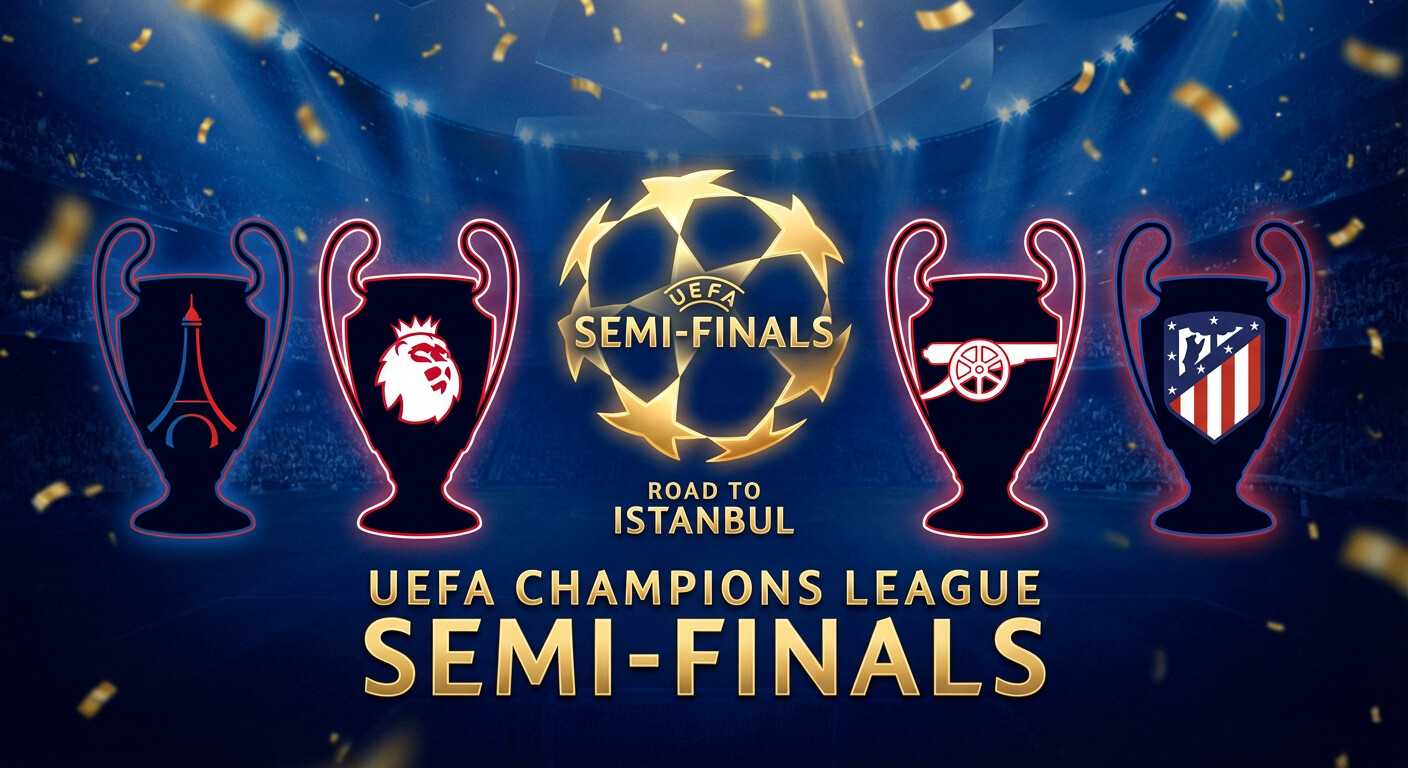
The 2025-26 UEFA Champions League semi-finals are set, and the four clubs who will contest the last four of Europe's most prestigious club competition represent a genuinely compelling cross-section of the continent's elite. Paris Saint-Germain, the defending champions, will face Bayern Munich in a rematch of some of European football's most memorable historic encounters. Arsenal, aiming for their first European Cup final in twenty years, will take on Atletico Madrid in a tactical contest that promises to test Mikel Arteta's progressive football against Diego Simeone's deeply-organised defensive system. With first legs scheduled for April 28 and 29 and second legs on May 5 and 6, the final four months of a remarkable Champions League season are about to produce their most significant chapters yet. The winner of each tie will meet at the Puskas Arena in Budapest on May 30 to contest the final.
How the Four Clubs Got Here
The path to the semi-finals has been dramatic for all four surviving clubs, and understanding the journey each side has taken to reach the last four provides essential context for what lies ahead. PSG dispatched Liverpool with clinical efficiency, winning both legs of the quarter-final to record a 4-0 aggregate victory that confirmed their status as the most dangerous team in the competition. Ousmane Dembélé, the Ballon d'Or winner, scored twice at Anfield in the second leg to complete a comprehensive elimination of a Liverpool side that had hoped Anfield's famous European atmosphere could inspire a fightback but found PSG too well-organised and too ruthlessly effective to be turned over. The defending champions have now won five consecutive knockout ties against English clubs in the Champions League, a record that reflects a deep understanding of how to neutralise Premier League opposition's directness and intensity.
Bayern Munich's route to the semi-finals was far more dramatic and demanded every ounce of the collective character that Vincent Kompany has instilled in his squad. Their quarter-final against Real Madrid produced what many observers described as one of the greatest matches in recent Champions League history, with Bayern winning the second leg 4-3 at the Allianz Arena after being 2-3 down at half-time, completing a 6-4 aggregate triumph that ended a decade of painful Champions League exits against the Spanish giants. Late goals from Luis Díaz and Michael Olise, following Eduardo Camavinga's controversial second yellow card, sent the stadium into scenes of extraordinary celebration and confirmed that this Bayern side has the mentality to deliver under the most extreme pressure. Our full coverage of that remarkable night is available in the Bayern vs Real Madrid match report.
Arsenal's progress to the semi-finals was built on defensive solidity and a crucial away goal, with Kai Havertz's stoppage-time winner in the first leg in Lisbon proving the decisive contribution across a quarter-final that was resolved by the finest of margins. The 0-0 draw in the second leg at the Emirates was not a comfortable evening, with Sporting creating enough chances to have equalised on aggregate, but David Raya's goalkeeping and Arsenal's ability to protect their lead confirmed Arteta's side as worthy semi-finalists. Atletico Madrid took a different route to the last four, winning the first leg 2-0 against Barcelona before surviving a dramatic second leg at the Metropolitano that required a crucial Lookman goal to restore their aggregate advantage after Barcelona had wiped out the two-goal deficit inside the opening twenty-five minutes.
PSG vs Bayern Munich: A Date With European History
The meeting between PSG and Bayern Munich is, on paper, the tie that brings together the two most decorated clubs in this season's competition, the two teams that have produced the most consistent quality across the knockout rounds. PSG arrive as holders with Dembélé in the form of his life, supported by a team that has demonstrated the ability to manage different types of opposition effectively and efficiently. Bayern bring the momentum of their extraordinary quarter-final victory, the clinical firepower of Harry Kane and Michael Olise, and the growing influence of Jamal Musiala, who changed the game against Real Madrid when introduced as a substitute and whose impact on the semi-final could be equally decisive.
The tactical contest between Luis Enrique and Vincent Kompany will be one of the most intellectually fascinating of any European semi-final in recent memory. Enrique's PSG are built on collective fluidity and the individual brilliance that Dembélé and Barcola provide in wide positions, while Kompany's Bayern have demonstrated throughout this campaign that they can adapt their approach depending on the demands of the occasion. Their control of possession, the pressing triggers they employ to win the ball back quickly, and the quality of their set-piece delivery all represent potential sources of advantage in a tie where individual moments are likely to prove decisive. For a deeper understanding of the tactical factors that define these semi-final matchups, our Champions League predictions guide explores the key variables in high-stakes European knockout football.
Bayern's defensive organisation will be tested by Dembélé's ability to operate between the lines and exploit space in transition, while PSG's press will need to cope with the intelligence and technical quality of a Bayern midfield that has performed at a high level throughout the knockout rounds. The first leg at the Parc des Princes on April 28 will set the tone, and the character both clubs have demonstrated in reaching the semi-finals suggests a tie that will go to the wire across both legs.
Arsenal vs Atletico Madrid: The Tactical Test of the Season
If the PSG versus Bayern match-up provides the glamour tie of the semi-finals, the contest between Arsenal and Atletico Madrid provides the tactical intrigue. These are two clubs whose approaches to football represent contrasting philosophies that have both proven effective at the highest level, and the question of which set of principles prevails across the two legs will define one finalist in Budapest. Arsenal, under Arteta's influence, have become one of the most organised and technically sophisticated teams in European football, built on a high defensive line, aggressive pressing from the front and the ability to control possession in a way that prevents opponents from building sustained periods of pressure. Atletico, under Simeone, have for fifteen years represented an entirely different model: deep defensive structure, compression of space, reliance on set pieces and counter-attacks, and an absolute refusal to be broken down by even the most technically gifted opponents.
The match-up creates specific tactical challenges for both managers. Arteta will need his team to maintain their composure and resist the temptation to commit too many bodies forward when Simeone's side are defended low in their own half, knowing that the space in behind will be ruthlessly exploited by Atletico's forwards in transition. The counter-attacking patterns that have served Atletico so well against Barcelona in the quarter-finals will be even more dangerous against a team as committed to high pressing and forward runs as Arsenal. Simeone, for his part, will need to organise his defensive structure to cope with the width that Bukayo Saka provides on the right side of Arsenal's attack, and to find a way of preventing the Gunners from establishing the kind of sustained territorial dominance that allows them to create the high-quality chances they have scored throughout the domestic season.
The Metropolitano on April 29 will be one of the most intimidating environments in European club football, and Arsenal's ability to remain defensively organised while carrying a threat on the break will be crucial in determining the overall character of the tie. The Arsenal team that held out for a 0-0 at the Emirates against Sporting has demonstrated it can suffer and endure, but Simeone's Atletico are a categorically more dangerous proposition than Sporting when playing at home and backed by their famously passionate support. Our analysis of motivation and match context provides essential reading for understanding how these specific dynamics will affect both teams' approaches.
The Road to Budapest
The Puskas Arena in Budapest will host the Champions League final on May 30, and the four teams competing for the right to play there represent a genuinely broad spread of European football's traditions and ambitions. PSG, backed by Qatar Sports Investments, are chasing a historic consecutive European title and demonstrating with every passing round that their investment in squad quality and coaching expertise is producing results on the grandest stage. Bayern represent German football's claim to the pinnacle of the game after years of domestic dominance without the European trophy to match. Arsenal are driven by the desire to deliver the club's first European Cup and to validate a multi-year project under Arteta that has already returned the club to the top of the Premier League. Atletico are motivated by Simeone's desire to finally win the trophy that has twice eluded him, and by a squad whose collective strength and commitment to the manager's methods makes them capable of defeating any opponent on their best day.
The semi-final schedule places the first legs on April 28 (PSG vs Bayern) and April 29 (Arsenal vs Atletico), with the return legs on May 5 and 6 respectively. A full analysis of how the fixture schedule will affect each club's domestic preparations, and how European match fatigue may influence performance levels, will be essential reading for those following both ties closely. The four clubs have earned their places in the last four through performances of genuine quality and character, and the semi-finals promise to deliver the drama and spectacle that this competition, at its best, consistently provides. The road to Budapest runs through some of the most iconic stadiums in European football, and the journey, for all four clubs, is about to reach its most thrilling stage.