
Bayern Munich 4-3 Real Madrid: Olise and Diaz Break Blancos Hearts in Champions League Classic

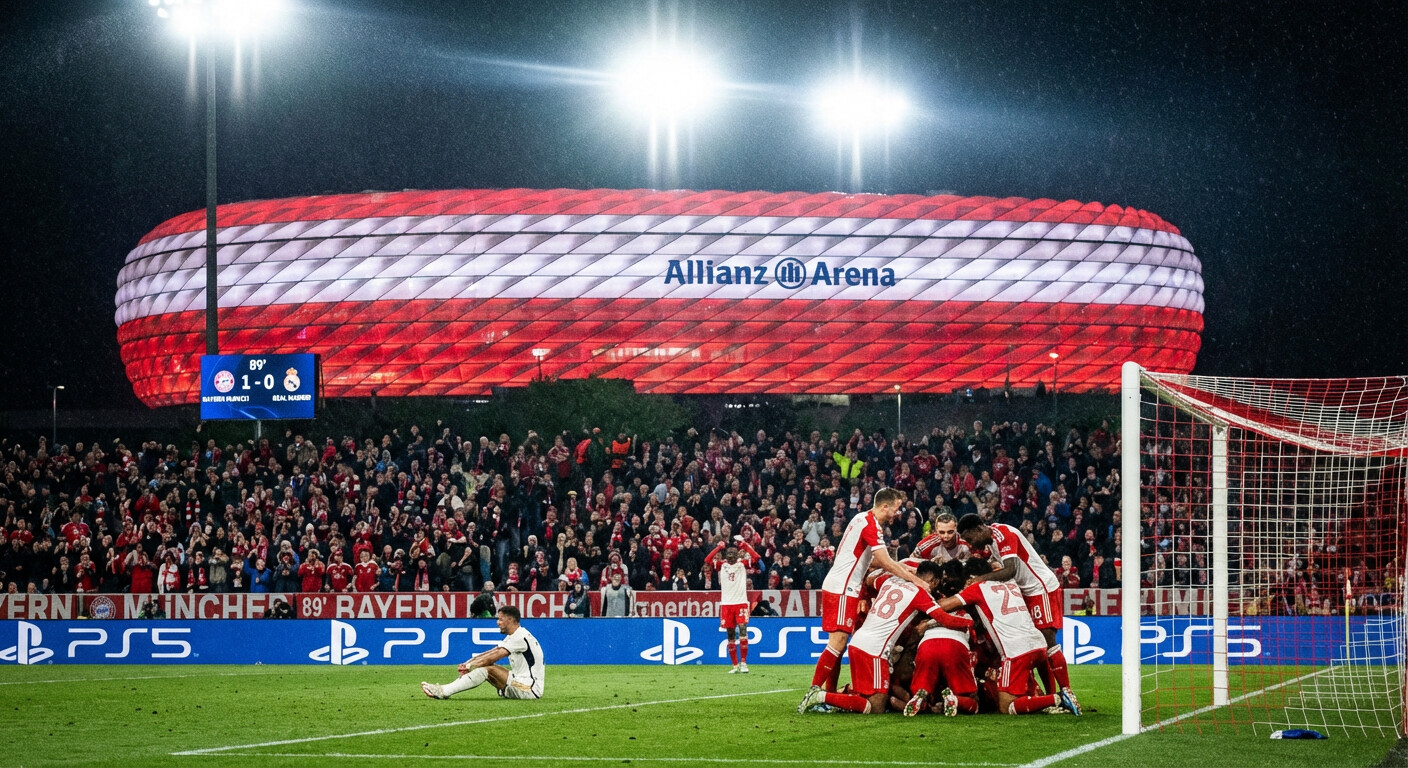
There are Champions League nights, and then there are the kind of nights that reshape the narrative of an entire era. What unfolded at the Allianz Arena on April 15, 2026, was emphatically the latter. Bayern Munich defeated Real Madrid 4-3 in one of the most extraordinary matches in the history of Europe's elite club competition, advancing 6-4 on aggregate to reach the Champions League semi-finals and ending the Bavarian club's decade-long run of heartbreak against the Spanish giants. Vincent Kompany, in just his second season as Bayern head coach, has done what no manager before him managed in a long and painful recent history against Real Madrid: he beat them on the biggest stage when it mattered most. And he did it in the most theatrical, nerve-shredding manner imaginable, with two goals in the final six minutes of normal time completing a breathtaking turnaround.
The Fastest Goal in Bayern's Champions League History
If the opening 35 seconds of this match felt like a bad dream for the home supporters, that is because they were. From the very first attack of the evening, Real Madrid's Arda Güler capitalised on a catastrophic error from Manuel Neuer, whose sloppy, misdirected pass handed the young Turkish midfielder the ball in acres of space. Güler needed no second invitation, finishing calmly past the stranded Bayern goalkeeper to make it 1-0 before most supporters had settled into their seats. It was the fastest goal Bayern Munich have ever conceded in the Champions League, and also the fastest Real Madrid have ever scored in the competition, bettering even Gareth Bale's opener in the 2016 group stage win over Legia Warsaw.
Had Bayern crumbled in the wake of that horror start, few neutral observers would have been entirely surprised. Instead, they did what Kompany has gradually conditioned this squad to do: they responded immediately and with complete conviction. In the sixth minute, Joshua Kimmich's precise corner from the right found the head of Aleksandar Pavlović at the near post, and the young German midfielder directed the ball into the net with a powerful, accurate header. 1-1. The Allianz Arena exhaled, and the match settled into a pattern of extraordinary end-to-end drama that would not relent for a single moment across the remaining 84 minutes.
Harry Kane Reaches His 50th Goal of the Season
The scale of the contest that developed across the next thirty minutes defies easy description. Real Madrid, showing no willingness to sit on their aggregate advantage, continued to attack with freedom and ambition, and Güler struck again in the 29th minute, this time whipping a free kick to Neuer's left that the keeper could only palm into the corner of his own net. 2-1 to Real Madrid. The aggregate was level. The match had taken on the quality of a heavyweight boxing match, with neither side willing to retreat into caution.
Harry Kane, who had been magnificently energetic and industrious throughout the opening half, restored parity in the 38th minute with a goal of characteristic composure. Dayot Upamecano found the England captain in the penalty area, and Kane swept the ball low into the bottom right corner for his 50th goal of the season in all competitions, a milestone that underlined what a remarkable campaign he has produced. His record against Real Madrid in the Champions League continues to be extraordinary, with Kane having scored or assisted in each of his last five knockout appearances against the Spanish giants, the longest such streak by any player in the competition's history against Real Madrid. For more on how clinical strikers impact European knockout ties, our Champions League predictions strategy guide explores the statistical patterns that make the difference at this level.
The first half finished 2-3 to Real Madrid, with Kylian Mbappé having restored the visitors' lead in the 42nd minute. Moments after Vinícius Junior had rattled the crossbar, it was the former PSG striker who punished Bayern for being caught in transition, cutting inside onto his left foot and finishing with clinical authority past Neuer. Mbappé's goal was his 15th of the season in the Champions League, making him the first player in the competition's history to score ten or more away goals in a single campaign. The first leg scoreline, in which Bayern had won 2-1 in Madrid, meant the tie was now level at 4-4 on aggregate going into the break. Everything remained to play for.
Musiala Changes Everything
The second half began with Bayern pushing for the goal they needed to retake the aggregate lead, but Real Madrid's defensive organisation made progress difficult. It was the introduction of Jamal Musiala from the substitutes' bench that fundamentally altered the nature of the contest. The 23-year-old, who had been carefully managed throughout the week to ensure he was fresh for the occasion, arrived on the pitch and immediately began making the difference that only genuinely elite players can make. His ability to find and exploit space in tight areas, to attract multiple defenders and then release team-mates into the gaps that created, gave Bayern a different dimension that they had been lacking in the second period.
Musiala's influence could be measured not just in the assist he would eventually provide but in the way his presence reorganised the entire Real Madrid defensive structure. Before his decisive contribution, he created a clear chance for Luis Díaz, who found himself one-on-one with goalkeeper Andrei Lunin but was denied by the Ukrainian's composed save. The miss threatened to become one of those painful moments that define a night in the wrong way. Instead, it proved merely a prelude to what was coming. For an analysis of how fixture congestion and squad management affect Champions League performance, our guide explores exactly the kind of tactical decisions that Kompany made brilliantly with Musiala's introduction.
Camavinga's Red Card and the Drama That Followed
The pivotal moment of the entire tie came in the 86th minute, when Real Madrid midfielder Eduardo Camavinga received his second yellow card and was dismissed from the field. His first booking had come for a foul on Musiala, and the second was shown after he appeared to kick the ball away following another foul, a decision that provoked fury among the Real Madrid players and coaching staff. The controversy surrounding the red card will be debated for weeks, but what happened in its aftermath was utterly decisive and entirely beyond argument.
Within two minutes of Camavinga's departure, Luis Díaz had scored the goal that tied the aggregate score in Bayern's favour. Musiala, operating in the space that the reduced Real Madrid midfield was struggling to cover, threaded a perfectly-weighted pass through the defence that found Díaz in a position to shoot. The Colombian forward's effort deflected off Éder Militão and past Lunin, and the Allianz Arena erupted with a ferocity that had been building throughout the second half. The aggregate score stood at 5-4 to Bayern with four minutes of normal time remaining, and the frantic final push from Real Madrid was met with increasingly desperate defending from Kompany's side.
Then, in the fourth minute of stoppage time, Michael Olise collected a precise pass from Kane on the right flank, cut inside onto his left foot, and bent a magnificent shot into the far corner of Lunin's net. The stadium shook. Olise's finish, executed with the calmness of a man who has been producing moments of this quality throughout a breakout debut Champions League season, completed an extraordinary 4-3 victory on the night and a 6-4 aggregate triumph that sent Bayern into the semi-finals for the first time in three seasons.
Breaking the Madrid Curse
The significance of what Bayern achieved at the Allianz Arena extends well beyond the immediate context of a quarter-final result. Vincent Kompany's team had not beaten Real Madrid in a Champions League knockout tie since 2012, losing on four successive occasions in what had become an increasingly painful psychological block. The German club had suffered exits in 2014, 2017, 2018 and 2024, with each defeat arriving in circumstances that made the next meeting feel increasingly daunting. To break that sequence with a 6-4 aggregate victory, coming from behind twice on the night and scoring twice in the final six minutes, represents an achievement that speaks to the mental resilience and collective belief that Kompany has built at the club.
For an understanding of how psychological factors and match importance influence European knockout football, our guide on match importance and motivation provides a framework for thinking about exactly these kinds of high-pressure scenarios. Kane, Olise and Díaz all produced performances that will be discussed for years, but it was the collective character of the entire squad that ultimately determined the outcome. Real Madrid, condemned to quarterfinal exits in consecutive seasons for the first time in their modern history, must now rebuild ahead of what is likely to be a significant summer of transition.
What This Means for Bayern's Season
Bayern Munich will now face Paris Saint-Germain in the semi-finals, a mouth-watering tie between two of European football's most high-profile clubs. PSG, who eliminated Liverpool 4-0 on aggregate in the other quarter-final, arrive as defending champions and will provide an entirely different tactical challenge from the one that Real Madrid posed. But on the basis of what Kompany's team produced against the most decorated club in the competition's history, Bayern will head into the last four with justified confidence that they have what it takes to go all the way.
Neuer, whose first-half error gifted the opening goal and who had an uneven evening overall, will be disappointed with his contribution but can take some solace from the relentless support his team mates provided. Kane, with 50 goals for the season and his best-ever Champions League scoring campaign now secured with 12 goals in the competition, looks increasingly like the decisive difference-maker that Bayern hoped he would become when they signed him. Olise and Musiala, both still in their early twenties, produced performances that suggested their very best years lie ahead. The Allianz Arena erupted, and the rest of Europe took note. Bayern Munich are back among the genuine contenders, and on this evidence, they mean business. You can follow the full story of this remarkable Champions League season in our coverage of the quarter-final build-up and the emerging semi-final picture.